
Felipe Hubner begins as a CME instructor in Brazil
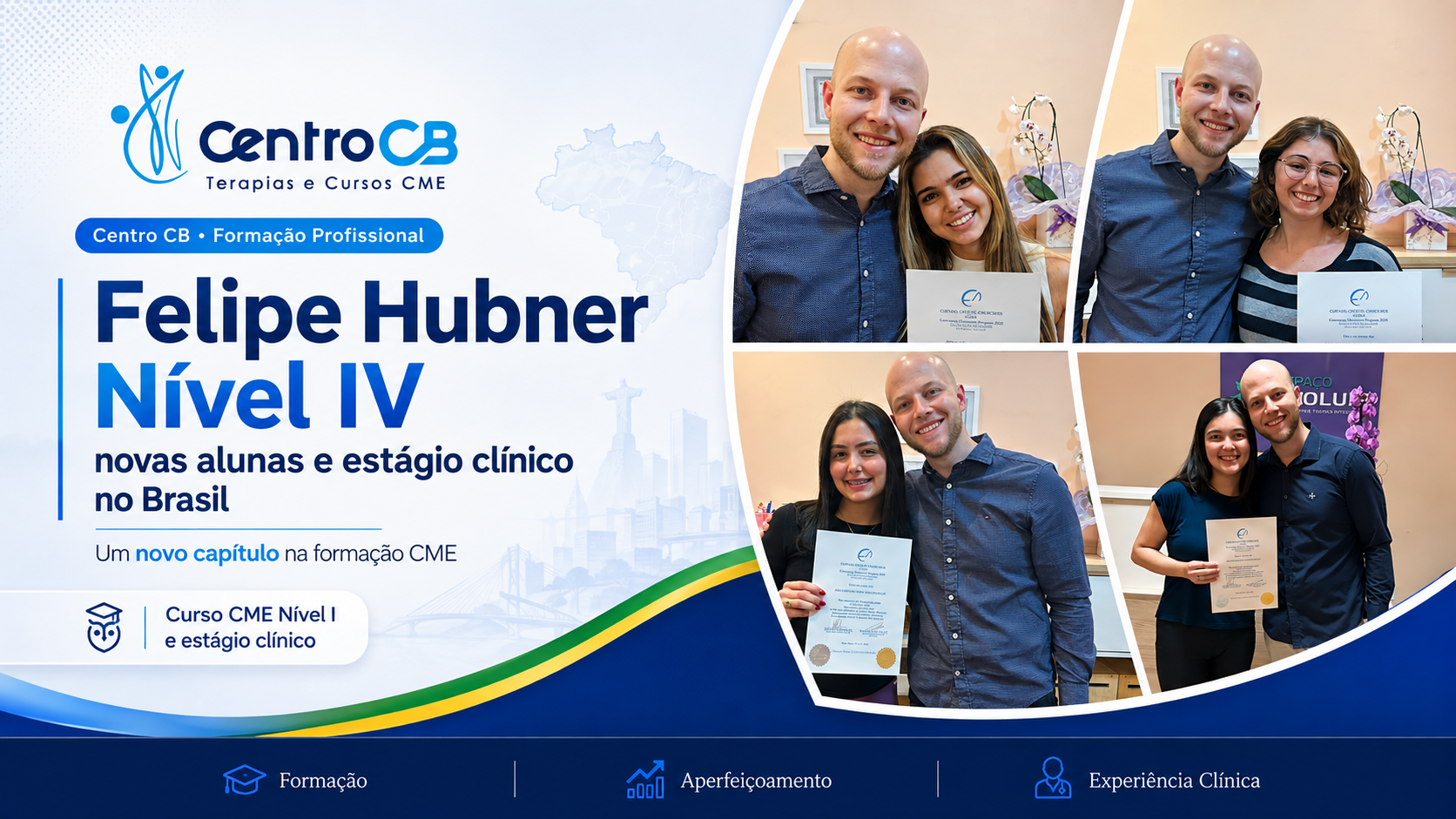
Felipe Hubner, a Level IV CME practitioner, conducts training sessions and clinical internships in Brazil.
Level IV CME therapist Felipe Hubner has begun a new professional phase in Brazil, leading his first Level I CME training courses and overseeing clinical internships.
Some professional achievements represent more than just the completion of a stage.
They shift the position a professional occupies within their career trajectory.
For therapist Felipe Hubner, reaching Level IV in Cuevas Medek Exercise (CME) meant exactly that.
After years dedicated to training, clinical practice, internships, evaluations, and technical refinement, Felipe has entered a new phase within the method: he has begun to take on a role in training and mentoring other therapists.
And the first chapters of this new phase are already being written in Brazil.
In addition to conducting his first Level I CME training sessions, Felipe also led a supervised clinical internship, mentoring a therapist who is already at a more advanced stage of development within the method.
Two distinct phases of CME training, both guided by the same instructor—illustrating, in practice, what it means to reach Level IV.
From therapist to CME instructor
Professional training in Cuevas Medek Exercise is built progressively.
Each level adds knowledge, exercises, clinical experience, therapeutic reasoning, and technical rigor.
To reach Level IV, a professional undergoes an extensive preparatory journey, encompassing previous levels, assessments, and further supervised clinical internships. Within the official training structure, Level IV represents the highest tier of clinical development and qualifies the professional to serve officially as an instructor of the method.
This certification, therefore, is more than just a personal achievement.
It brings with it a new responsibility:
to participate in the training of the professionals who will carry the CME method forward.
And this is precisely what Felipe has begun to experience.
CME Level I Training: where new paths begin
For some of the therapists mentored by Felipe, this encounter marked the start of their journey within Cuevas Medek Exercise.
Level I is the foundational training for CME.
It is here that the professional begins to study the historical and conceptual foundations of the method, learns the CME assessment scale, encounters various exercises, and starts developing the proficiency required for its application.
It is an initial stage, yet a fundamental one.
This is because, before moving on to more complex exercises and higher levels, a technical and conceptual foundation must be built.
Now, Felipe has begun to take a direct part in this foundational process.
He has moved beyond the role of someone who merely learned, practiced, and advanced within the CME framework; he has now also taken on the mission of teaching the core fundamentals to new professionals.
Clinical internship: a new level of guidance
However, the record of this new phase in Felipe’s professional life was not limited to Level I courses.
His activities also included the supervision of clinical internships.
And there is an important distinction between these two stages.
While Level I introduces the professional to the method, the clinical internship takes place during a phase focused on professional refinement.
Within the official structure of the CME training program, supervised internships are an integral part of the progression between levels and are directly overseen by an instructor CME. Their objective includes expanding the repertoire of exercises, deepening clinical analysis, and enhancing the technical quality of what is termed “manual dexterity in the application of the CME method.”
This is the stage where what has been learned begins to be examined with even greater depth within the clinical reality.
The therapist must develop not only the ability to perform an exercise but also the capacity to understand when to use it, why it should be chosen, and how to conduct it with precision.
In this process, the role of the instructor becomes essential.
Observing.
Correcting.
Demonstrating.
Questioning.
Refining details.
Sharing clinical reasoning.
Because, within a progressive training program, technical evolution does not occur through repetition alone.
It also depends on the quality of the supervision.
Two different stages of the training program—yet the same responsibility.
These initial experiences of Felipe as an instructor reveal something particularly interesting.
On one hand, there are therapists beginning their journey within the CME framework through Level I.
On the other, there is a professional who has already advanced in her training and is now seeking further refinement through a clinical internship.
Beginning and continuity.
Training and refinement.
Knowledge and clinical experience.
These are distinct stages, yet they are part of the same structure.
And now, Felipe occupies an important role in both.
When knowledge begins to multiply…
There is a special symbolism in this moment for CME in Brazil.
Every instructor, before teaching, was once a student.
They, too, had to learn methods of manual support.
They, too, had their exercises corrected.
They, too, underwent evaluations.
They, too, completed clinical internships.
They, too, had to develop their dexterity and clinical reasoning.
Felipe has traveled this path.
He has reached Level IV.
And now, he begins to do for other therapists what other professionals did during his own training: supporting the process of professional growth.
That is why these initial training programs and this clinical internship represent much more than just new certificates.
They represent continuity.
A new generation begins to learn, while another continues to advance.
And a professional who has spent years building his own trajectory now helps other therapists build theirs.
For Centro CB, this is a moment worth noting.
Because the growth of CME does not happen solely when new professionals join the method.
It also occurs when highly skilled professionals reach the point of training, supervising, and contributing to the technical development of those who follow in their footsteps.
Level IV marked an important achievement in the journey of Felipe Hubner.
Now, the first CME Level I training sessions and the supervision of the first clinical internship reveal something even more significant:
a new chapter in this journey has already begun.
Automatic translation of the original article. Read the Portuguese original