
CME arrives in Bolivia: training in Santa Cruz de la Sierra
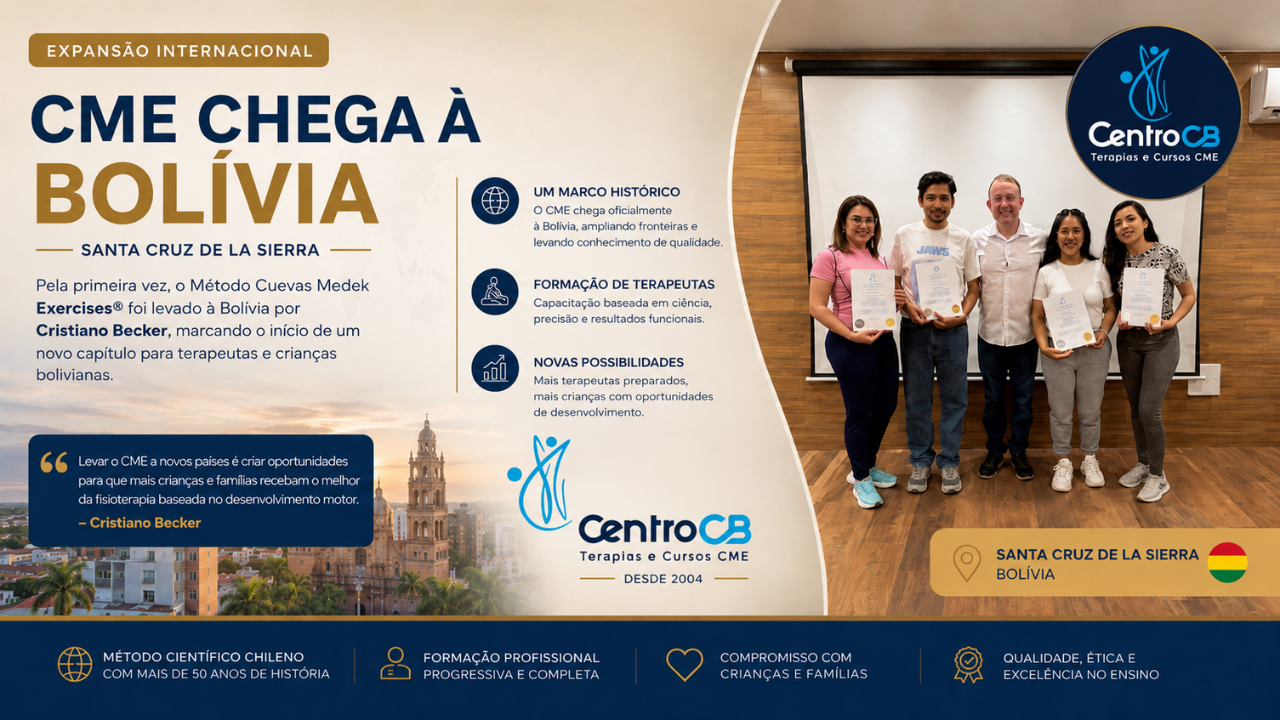
CME arrives in Bolivia for the first time, led by Cristiano Becker.
Santa Cruz de la Sierra hosted a historic training session with Cristiano Becker, bringing Cuevas Medek Exercise to Bolivia and initiating a new chapter in the international expansion of CME.
Some professional journeys represent much more than just another entry on an international calendar.
They mark the beginning of a story.
This is what took place in Santa Cruz de la Sierra, where Cristiano Becker introduced Cuevas Medek Exercise to Bolivia for the first time, further extending the reach of the method.
This arrival in the country marks a special moment for Centro CB and for the international path that Cristiano has built over the last few years.
Yet another country has now gained firsthand exposure to the principles, assessment methods, and exercises that comprise CME.
A new territory for Cuevas Medek Exercise.
CME originated in Latin America.
It was developed by the Chilean physical therapist Ramón Cuevas, based on clinical work that began in Venezuela during the 1970s.
Since then, the method has evolved, established its own framework for assessment and professional training, and crossed borders.
Decades after those initial clinical experiences, this body of knowledge continues to spread across the globe.
And this time, its destination was Bolivia.
Santa Cruz de la Sierra became the setting for yet another historic milestone in this expansion.
Much more than just presenting exercises
Bringing CME to a new country means more than simply demonstrating techniques.
A training program must convey the logic that underpins each exercise.
One of the fundamental characteristics of CME is the effort to elicit absent motor functions and automatic motor and postural control responses, using specific dynamic exercises and progressive exposure to the force of gravity.
Another key principle involves the use of increasingly distal points of support, tailored to the child’s current capabilities—a process that demands both precision in execution and a biomechanical understanding from the therapist.
This is precisely why there is a professional training program structured into different levels.
Knowledge must go hand in hand with technical skill.
Cristiano Becker and the international expansion of the method
The presence of Cristiano Becker in various countries has helped connect therapists with the official CME training process.
Each trip represents new possibilities for professional exchange, as well as a responsibility: to preserve the quality of what is being taught.
In Bolivia, this responsibility took on even greater significance, as it marks the beginning of a new chapter for the method in that country.
The first steps have been taken.
Through this training, Bolivian professionals are beginning to incorporate new knowledge into their practice, and CME now occupies a new space on the international map.
From one country to the world
The history of CME has always been linked to movement.
The movement of children.
The movement of therapists in search of professional development.
And the movement of a body of knowledge that originated in Latin America and has reached various continents.
Now, Bolivia, too, has become part of this story.
For Cristiano Becker and Centro CB, arriving in Santa Cruz de la Sierra means more than just adding another country to the list of places visited.
It means opening doors.
Creating connections.
Training professionals.
And ensuring that a body of knowledge developed over five decades ago continues to find new therapists willing to study it in depth.
CME has arrived in Bolivia.
And this is only the first chapter of a story that has the potential to grow much further.
Automatic translation of the original article. Read the Portuguese original